Launch the CAPSENSE™ Configurator
There are several ways to launch the CAPSENSE™ Configurator, and those ways depend on how you use the various tools in ModusToolbox™. However, the easiest way is to launch it using the Device Configurator because you can configure the rest of the parameters for your application right there. Refer to Device Configurator user guide for more details.
From the Device Configurator
You can launch the CAPSENSE™ Configurator by using the Device Configurator. The Device Configurator displays information based on the design.modus file. When you open the CAPSENSE™ Configurator from the Device Configurator, information about the device and the application is passed to the CAPSENSE™ Configurator. When you save changes in the CAPSENSE™ Configurator, it updates/generates a design.cycapsense configuration file in the same location as the design.modus file. For information about how to launch the Device Configurator, refer to the Device Configurator user guide.
The process to launch the CAPSENSE™ Configurator from the Device Configurator differs slightly depending on the hardware block:
-
The 4 th generation CAPSENSE™ – one CSD resource
-
The 5 th generation CAPSENSE™ – two or more MSC resources
-
The 5 th generation LP CAPSENSE™ – one MSCLP resource
-
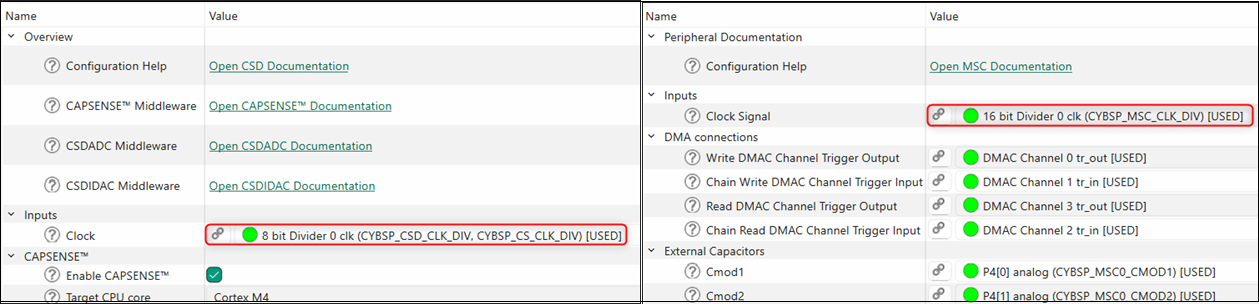
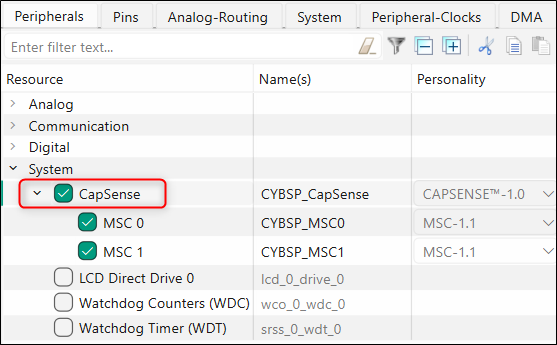
On the Peripherals tab, select the CSD (CapSense) resource or the CapSense and one or more MSC or MSCLP resources, as applicable for your device.

-
(Skip this step for MSCLP). On the Parameters pane, select an appropriate input Clock for CSD (CapSense) and CapSense respectively.
-
For the MSC and MSCLP HW blocks, select the CapSense resource category on the Peripherals tab.
-
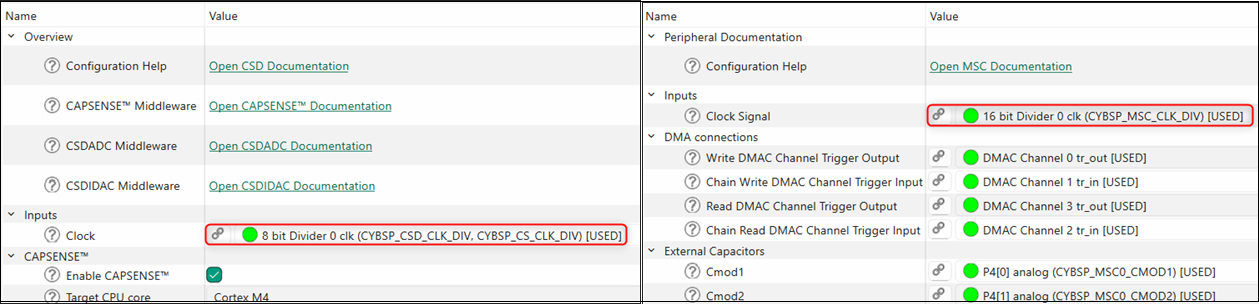
On the Parameters pane, click the Launch CAPSENSE™ Configurator button.
make command
As described in the ModusToolbox™ tools package user guide "ModusToolbox™ Build System" chapter, you can run numerous make commands in the application directory, such as launching the CAPSENSE™ Configurator. After you have created a ModusToolbox™ application, navigate to the application directory and type the following command in the appropriate bash terminal window:
make capsense-configurator
This command opens the CAPSENSE™ Configurator GUI for the specific application in which you are working.
VS Code and Eclipse IDE
VS Code and Eclipse have tools to launch the CAPSENSE™ Configurator from within an open application. Refer to the applicable user guide for more details:
Executable (GUI)
If you don't have an application or if you just want to see what the configurator looks like, you can launch the CAPSENSE™ Configurator GUI by running its executable as appropriate for your operating system. By default, it is installed here:
[install_dir]//ModusToolbox/packs/ModusToolbox-Multi-Sense-Pack/tools/capsense-configurator
When opened this way, the CAPSENSE™ Configurator GUI opens blank without any information.
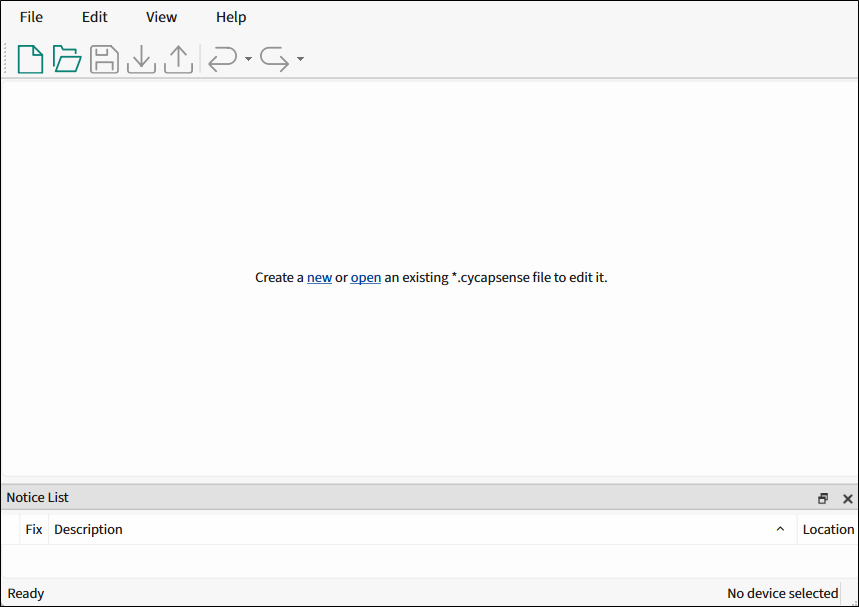
You must open an existing *.cycapsense file or create a new one for the application in which you want to configure CAPSENSE™, and it must be in the same directory as the design.modus file.
Executable (CLI)
You can run the capsense-configurator executable from the command line. There is also a capsense-configurator-cli executable, which regenerates source code based on the latest configuration settings from a command-line prompt or from within batch files or shell scripts. The exit code for the capsense-configurator-cli executable is zero if the operation is successful, or non-zero if the operation encounters an error. To use the capsense-configurator-cli executable, you must provide at least the --config argument with a path to the configuration file.
For details about command-line options, run the capsense-configurator or capsense-configurator-cli executable using the -h option:
`Provides the command-line interface for generating CAPSENSE(TM) Configurator output files.
Options: -?, -h, --help Displays help on commandline options. --help-all Displays help including Qt specific options. -v, --version Displays version information. -c, --config [config_file] Path to the configuration file. -o, --output-dir [dir] The path to the generated source directory. It is either an absolute path or a path relative to the configuration file parent directory. --clean Removes the generated files from the output folder.`
Parallel design
With Device Configurator
You can simultaneously open the CAPSENSE™ and Device Configurators and share data between these applications. The introduced "edit-lock" mechanism takes over the ownership of the write operation and allows only one application to make changes to the design.modus file once until the save-to-disk operation is complete. The design.modus file-related changes made in one application are reflected in the other opened applications.
With CAPSENSE Tuner
You can simultaneously open the CAPSENSE™ Configurator and Tuner to work with the same [file_name].cycapsense configuration file. To get the values in the CAPSENSE™ Configurator, which were updated in the CAPSENSE™ Tuner, use the Import option or reopen the CAPSENSE™ Configurator.