General tab (Option1, Option3)
The
General
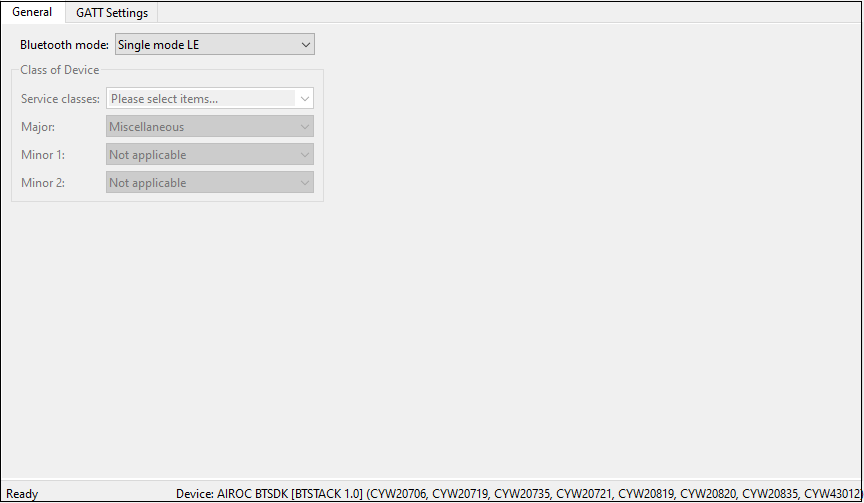
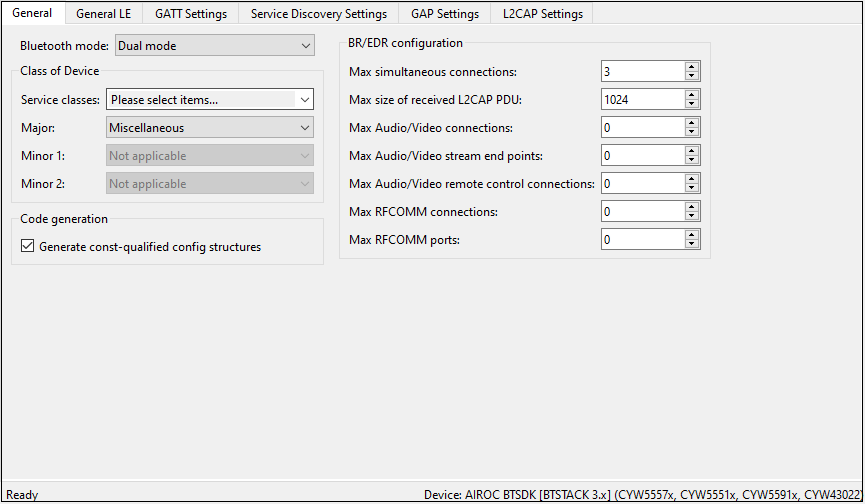
tab allows general configuration of the Bluetooth® resource and displays depending on the mode selected:
for Option1
for Option3
The following chapters describe the
General
tab settings for
Option1
and
Option3
.
Bluetooth® mode
The Bluetooth® mode parameter supports the following functionality in different modes:
Single mode LE – Only the Low Energy.
Single mode BR/EDR – Only the Basic Rate (BR)/Enhanced Data Rate (EDR) or "classic" Bluetooth®.
Dual mode – Both the Low Energy and BR/EDR.
Class of device
The Class of Device group of parameters indicates the device type and is available in Single mode BR/EDR or Dual mode :
Service classes – Defines the general categories of devices your application will be associated with.
Major – Defines the main device’s function.
Minor 1 – Extends the Major device class value.
Minor 2 – Extends the Major device class value.
Isochronous Connection configuration
The
Isochronous Connection
configuration group is located in the
General LE
tab and is available in
Single mode LE
, and
Dual mode
. Isochronous Channels support is one of the main new features added in Bluetooth® specification 5.2. In conjunction with new GATT Audio profiles, it supports Bluetooth® LE Audio transport. LE Audio exists in the two main forms:
Multi-Stream Audio – Supports the connection between an audio source device and one or more audio sink devices. It is bidirectional, with acknowledgments.
Auracast™ Broadcast audio. – Supports the broadcasting of one or more audio streams from the source to an unlimited number of sink devices. It is unidirectional, without acknowledgments.
Isochronous Connection configuration
parameters:
Max SDU size – The maximum size of Service Data Unit (octets).
Max audio channels per packet – The maximum number of audio channels (left, right …) contained in one packet.
Max number of CIS connections – The maximum number of Connected Isochronous Stream connections. CIS is point-to-point, bidirectional connection between the central and peripheral device.
Max number of CIG connections – The maximum number of Connected Isochronous Groups. CIG is the group of one or more Connected Isochronous Streams created by the central device.
Max number of buffers per CIS – The maximum number of buffers per one Connected Isochronous Stream.
Max number of BIG connections – The maximum number of Broadcast Isochronous Groups. BIG is the group of one or more Broadcast Isochronous Streams created by the Isochronous Broadcaster device.
BR/EDR configuration
The
BR/EDR configuration
group of parameters is available only for
Single mode BR/EDR
and
Dual mode
:
Max simultaneous connections
Max size of received L2CAP PDU
Max Audio/Video connections
Max Audio/Video stream end points
Max Audio/Video remote control connections
Max RFCOMM connections
Max RFCOMM ports